
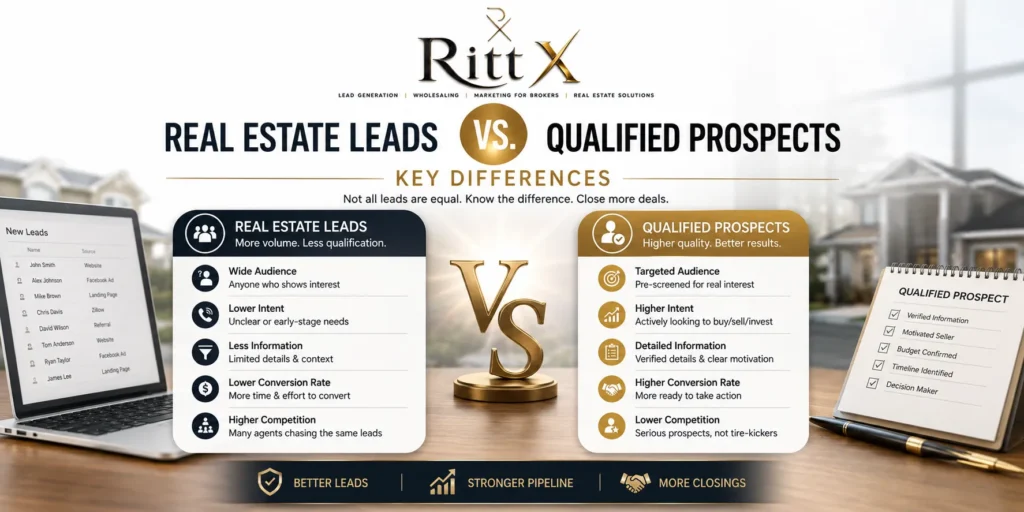
Real estate agents often use the words lead and prospect as if they mean the same thing. They are related, but there is an important difference between the two.
A real estate lead is usually someone who has shown some level of interest in buying, selling, or learning more about a property. That interest may come from an online form, advertisement, property search, social media campaign, phone inquiry, referral, or another marketing source.
A qualified prospect has moved a step further. More information is available about the person, their real estate needs have been evaluated, and there are stronger signs that the opportunity may be worth an agent’s time.
That difference can have a major impact on how agents manage their pipelines.
A database filled with hundreds of names may look impressive, but volume alone does not create transactions. Agents still need to determine which people have a genuine need, which fit their market, which are ready to have a conversation, and which may eventually become clients.
Understanding the difference between real estate leads and qualified prospects helps agents focus their time where it has the greatest potential value.
What Is a Real Estate Lead?
A real estate lead is a person who has entered the early stage of an agent’s marketing or sales pipeline.
The person may have expressed interest in buying or selling, but their actual intent is not always clear yet. In many cases, the agent has only basic information such as a name, email address, phone number, or property inquiry.
Real estate leads can come from many sources, including paid advertising, listing websites, social media, search engines, open houses, referrals, direct mail, landing pages, and lead-generation companies.
Someone might become a lead because they downloaded a home-buying guide, requested an online home valuation, clicked an advertisement, viewed a property, or submitted a form asking for more information.
These actions are useful signals, but they do not automatically mean the person is ready to buy or sell.
Salesforce describes leads as early-stage potential customers who still require qualification before they can be treated as stronger sales opportunities.
That same principle applies to real estate.
A lead gives the agent a possible opportunity.
Qualification determines how strong that opportunity actually is.
What Is a Qualified Real Estate Prospect?
A qualified real estate prospect is a lead whose situation has been evaluated more closely.
Instead of having only a phone number or email address, the agent or lead provider has additional information that helps determine whether the person has a genuine real estate need and whether the opportunity is a good fit.
For a seller, qualification may involve understanding ownership, motivation, property status, selling timeline, and willingness to speak with a real estate professional.
For a buyer, it may involve budget, financial readiness, purchase timeline, location, decision-making ability, and willingness to work with an agent.
The goal of qualification is not to predict the future perfectly. A qualified prospect can still change their mind.
Qualification simply reduces uncertainty.
HubSpot similarly defines a prospect as a lead that has been evaluated and confirmed as a stronger potential fit rather than someone showing only initial interest. HubSpot’s lead vs. prospect explanation
For real estate agents, that means a qualified prospect generally provides more context, clearer intent, and a better starting point for a productive conversation.
Real Estate Lead vs. Qualified Prospect: The Main Difference
The simplest difference is qualification.
A lead has shown some level of interest.
A qualified prospect has been evaluated to determine whether that interest represents a meaningful real estate opportunity.
Here is a simple comparison:
| Real Estate Lead | Qualified Real Estate Prospect |
|---|---|
| May have shown basic interest | Interest has been evaluated |
| Intent may be unclear | Motivation is better understood |
| Timeline may be unknown | Timeline has been discussed or confirmed |
| Contact data may be basic | Important information has been reviewed |
| Market fit may be uncertain | Opportunity is more closely matched |
| Agent must perform more screening | Some qualification has already taken place |
| May require significant nurturing | May be closer to a direct sales conversation |
| Quality varies widely | Stronger qualification standards are applied |
Neither category guarantees a closing.
The difference is how much useful information exists before the agent invests more time.
Why Traditional Real Estate Leads Can Be Difficult to Convert
Traditional online leads can work, but they often require significant effort from the agent.
Suppose someone sees an advertisement offering a free home valuation and enters their contact information.
The agent receives a name, email, and phone number.
At that point, several questions remain unanswered.
Does the person actually own the property? Are they planning to sell? When are they considering moving? Is the property already listed? Are they simply curious about its value? Are they willing to speak with an agent?
Until those questions are answered, the contact remains an early-stage lead.
This is one reason agents can spend hours calling and following up with people who never move forward.
As discussed in Ritt-X’s approach to real estate lead generation strategies, attracting attention is only the first part of the process. Targeting, segmentation, personalization, and qualification help determine what happens after someone enters the pipeline.
The challenge is not always generating more contacts.
Often, it is identifying which contacts deserve attention first.
What Makes a Real Estate Prospect Qualified?
There is no universal qualification checklist that works for every agent, market, and transaction.
However, several factors can help determine whether a lead is becoming a stronger prospect.
1. Accurate Contact Information
The first requirement is simple: the person should be reachable.
Incorrect phone numbers, fake email addresses, duplicate contacts, and outdated information create unnecessary work.
A prospect does not become qualified simply because the phone number works, but accurate information is an important foundation.
2. Genuine Real Estate Intent
Someone browsing property photos is different from someone actively planning a move.
Qualification should help determine whether the person has a genuine reason to buy or sell.
For a seller, there may be a specific reason behind the move, such as relocation, downsizing, upsizing, financial changes, investment decisions, or a lifestyle change.
For a buyer, the person may have started planning their purchase, researching areas, arranging financing, or identifying specific housing needs.
The stronger the intent, the more useful the opportunity may become.
3. A Realistic Timeline
Timing is another important qualification factor.
A seller planning to move within several months normally requires a different level of attention than someone who might consider selling “someday.”
The same applies to buyers.
A person with an active purchase timeline may need immediate help, while an early-stage buyer may need longer-term nurturing.
Neither prospect is necessarily worthless. They simply belong in different stages of the pipeline.
4. Market and Territory Fit
A genuine real estate prospect may still be the wrong opportunity for a particular agent.
Location matters.
Property type matters.
Price range may matter.
An agent specializing in residential properties within a specific county may not be the right professional for a commercial property hundreds of miles away.
Good qualification helps determine whether the prospect matches the agent’s actual market and expertise.
5. Financial Readiness
Financial readiness is especially important with buyer leads.
A person may be genuinely interested in buying but still need to understand financing, prepare funds, obtain pre-approval, or resolve other financial matters.
Knowing where the buyer stands gives the agent better context.
Ritt-X’s current qualified buyer lead criteria include factors such as budget, decision-maker confirmation, proof of funds or pre-approval, timeline, and willingness to speak with an agent. View Ritt-X qualified lead criteria and pricing
6. Willingness to Speak With an Agent
Intent becomes more meaningful when the prospect is willing to have a real conversation.
This is one of the biggest differences between a raw online inquiry and a more developed prospect.
A person may submit a form and ignore every follow-up attempt.
Another person may be prepared to discuss their needs directly with a professional.
That does not guarantee a transaction, but it creates a much more useful starting point.
Lead Generation and Lead Qualification Are Not the Same Thing
Lead generation focuses on attracting potential buyers and sellers.
Lead qualification focuses on determining which of those people deserve additional sales attention.
The two processes work together, but they solve different problems.
For example, targeted advertising might generate 100 inquiries. Qualification then helps determine which of those contacts have the right combination of intent, timing, fit, and readiness.
Without lead generation, the pipeline may be empty.
Without qualification, the pipeline may become crowded with contacts the agent cannot prioritize effectively.
That is why a strong real estate growth strategy needs both.
Why Qualified Prospects Can Save Agents Time
Time is one of the biggest hidden costs in real estate lead generation.
A weak lead may require repeated phone calls, texts, emails, CRM updates, and follow-up tasks before the agent learns that the person was never serious.
One contact may not seem like a major problem.
Multiply that by dozens or hundreds of weak leads and the amount of lost time becomes significant.
Lead qualification helps move some of that screening earlier in the process.
Salesforce notes that qualification allows sales professionals to focus limited time and resources on better-fit opportunities instead of pursuing contacts unlikely to convert.
For real estate agents, this means more time can be spent on meaningful conversations, listing appointments, buyer consultations, showings, negotiations, and existing clients.
Does Qualified Mean Ready to Close?
No.
This is one of the most important distinctions agents should understand.
A qualified prospect is not the same as a guaranteed client.
Someone can have genuine motivation, accurate information, a realistic timeline, and a willingness to speak with an agent and still change direction later.
A seller might delay a move.
A buyer might experience a financing change.
Family circumstances can change.
Market conditions can influence decisions.
The prospect may also choose another professional.
Qualification improves the quality of the starting point. It does not control what happens afterward.
This is why strong qualification must still be combined with good communication and consistent follow-up.
What Happens to Qualified Prospects Who Are Not Ready Yet?
Not every qualified prospect needs an immediate sales push.
A seller might genuinely plan to move but not for another four months. A buyer may have a real purchase goal but need more time to prepare financially.
These prospects should often enter a structured nurturing process rather than being treated as lost opportunities.
Good nurturing can include relevant market information, property updates, useful buying or selling guidance, personal check-ins, and scheduled follow-up based on the person’s timeline.
Ritt-X’s lead nurturing approach focuses on personalized communication, multi-stage nurturing, AI filtering, and ISA verification designed to better understand prospects before they move deeper into the pipeline.
The purpose is not to pressure someone into moving faster.
It is to maintain a useful relationship until their timing becomes stronger.
Raw Leads vs. Verified Leads vs. Qualified Prospects
Agents may also encounter several similar terms when comparing real estate lead providers.
Understanding the difference can make evaluating a service easier.
Raw Lead
A raw lead normally contains basic information generated from an advertisement, landing page, list, or another source.
There may be little or no human qualification.
Verified Lead
A verified lead has undergone some level of checking.
Verification might include confirming contact information, property details, ownership, or other relevant information.
However, agents should always ask what the provider means by “verified.” The term can describe very different processes depending on the company.
Qualified Prospect
A qualified prospect has moved beyond basic data verification. The prospect’s needs, intent, fit, timeline, financial position, or other relevant factors have been evaluated.
Qualification therefore adds context to verification.
This is why agents should avoid choosing a service based only on marketing terms.
Ask what actually happens before the prospect reaches you.
Why Live Conversations Add Another Level of Qualification
Forms and data can tell agents a lot.
A conversation can reveal even more.
Tone, questions, concerns, timing, motivation, and expectations become easier to understand when the prospect speaks directly with a professional.
Ritt-X uses this principle in its current live-transfer process.
Before an accepted seller lead is handed over, Ritt-X says it verifies factors such as accurate contact information, ownership, off-market status, motivation, and a selling timeline. The agent then participates in a live three-way introduction and gets an opportunity to evaluate the seller before formally accepting the lead. See how the Ritt-X live lead process works
That process adds a stage between basic qualification and final lead acceptance.
The agent is not simply looking at data on a screen.
They are able to hear from the prospect before deciding whether the opportunity belongs in their pipeline.
How Ritt-X Approaches Qualified Real Estate Prospects
Ritt-X is built around the idea that agents should receive more than basic contact information.
Its current lead model combines pre-qualification, live introductions, agent vetting, and exclusive assignment.
For motivated seller opportunities, Ritt-X currently verifies several factors before the introduction, including contact information, property ownership, off-market status, selling motivation, and a timeline of six months or less.
For qualified buyer leads, current criteria can include financial readiness, budget, decision-making status, purchase timeline, and readiness to speak with an agent.
The agent then gets the opportunity to evaluate the prospect before formally accepting the lead.
Once accepted, Ritt-X states that the lead is exclusively assigned to that agent rather than shared or redistributed to another Ritt-X agent.
This means the process is designed around three layers:
Qualification creates context.
The live conversation helps the agent evaluate fit.
Exclusive assignment reduces competition within the Ritt-X network.
Agents can review the complete Ritt-X lead process or compare current Ritt-X verified lead options before deciding whether the model fits their business.
Real Estate Leads vs. Qualified Prospects: Which Is Better?
The answer depends on what the agent needs.
Raw or early-stage leads can be valuable when agents have strong internal systems for qualification, automation, nurturing, and outbound follow-up.
They may also work well for teams that want high volume and have staff dedicated to sorting and contacting large databases.
Qualified prospects may be more attractive to agents who want to spend less time performing initial screening and more time speaking with people whose real estate situation has already been evaluated.
The important issue is not whether one category is always “good” and the other is always “bad.”
The real question is:
How much qualification work do you want to perform before reaching the actual sales conversation?
Agents should evaluate lead sources based on the complete process, not simply the number of contacts promised.
What Agents Should Ask Before Buying Real Estate Leads
Before choosing a lead-generation service, agents should ask several practical questions.
How are the leads generated?
Understanding the original source can help explain the prospect’s initial level of intent.
What does qualified mean?
Ask exactly which information is confirmed before delivery.
Are contact details verified?
Accurate information should be one of the basic requirements.
Is motivation discussed?
Knowing why someone may buy or sell provides important context.
Is the timeline known?
Timing affects whether the prospect needs immediate attention or longer nurturing.
Are leads shared with other agents?
A qualified prospect may become less attractive if several agents receive the same information simultaneously.
Can I speak with the prospect before committing?
A live conversation can provide information that does not appear in a form.
How does pricing work?
Understand whether the service uses subscriptions, referral fees, per-lead fees, or another structure.
Ritt-X currently uses a pay-per-accepted structure rather than monthly subscriptions or prepaid lead bundles. Agents evaluate the prospect through the live process and pay after formally accepting an opportunity according to the applicable terms. Review Ritt-X lead pricing
How Agents Can Convert Qualified Prospects More Effectively
Better prospects can improve the starting point, but the agent still determines much of what happens afterward.
Begin by reviewing everything you already know before speaking with the prospect. Repeating questions that have already been answered can make the process feel disconnected.
During the conversation, focus on motivation rather than immediately pushing for an appointment. Understand what is causing the person to consider a move and what would need to happen for them to take the next step.
Set a specific follow-up action instead of ending with a vague promise to reconnect. Depending on the situation, this may be a listing consultation, buyer consultation, market analysis, financing discussion, property search, or future check-in.
Finally, document the conversation inside the CRM. Record motivation, timeline, objections, important details, and the next follow-up date.
A qualified prospect can still disappear when follow-up is inconsistent.
Frequently Asked Questions
What is the difference between a real estate lead and a prospect?
A real estate lead is generally an early-stage contact who has shown some level of interest in buying or selling. A prospect has been evaluated further and shows stronger signs of being a realistic fit for the agent or service.
What is a qualified real estate prospect?
A qualified real estate prospect is someone whose needs and readiness have been evaluated using factors such as motivation, timeline, location, financial readiness, ownership status, or willingness to speak with an agent.
Are qualified prospects better than regular real estate leads?
Qualified prospects can provide agents with more information and reduce the amount of initial screening required. However, qualification does not guarantee that the person will become a client or complete a transaction.
What makes a seller lead qualified?
Seller qualification may include confirming the homeowner’s identity and ownership, property status, motivation, timeline, market fit, and readiness to speak with a real estate professional.
What makes a buyer lead qualified?
Buyer qualification may consider budget, preferred market, financing or proof of funds, decision-making ability, purchase timeline, and willingness to work with an agent.
Are verified real estate leads the same as qualified prospects?
Not always. Verification usually means certain information has been checked. Qualification goes further by evaluating whether the person’s situation, intent, needs, and timing make them a stronger potential opportunity.
Do qualified real estate prospects guarantee closings?
No. Qualification improves the starting quality of an opportunity, but consumers can change their plans. The agent still needs to build trust, provide value, follow up, and earn the business.
Where can agents find qualified real estate leads?
Agents can generate and qualify their own prospects through advertising, referrals, networking, content marketing, prospecting, and nurturing systems, or work with lead-generation providers that perform qualification before connecting the agent with the prospect.
Read Also: Rittx Reviews: What Real Estate Agents Should Know